Slow and calmeddown operators after front-striking era.
As Stickney proposed in his patents of US676208 or US889344, the risk to collide typebars each other was increased in change from up-strike to front-strike.
But the direction and the stream to change from up- to front- did not change and continued.
Without Stickney's patents of these execution.
Why? Visible, yes. But besides..
It was said. To strike keys in rapid one after another , would make collision or lead to the jamming together of typebars.
So why they do not jam so badly in front-strike era?
Because typist became slow.
Slow against quick or harry haste or rapid.
Even pacing.
Even if the typing speed is fast, if the interval of sequential keying is kept enough, typebars do not collide.
3/27/2014

3/25/2014
What the (touch) typing is possible means.
What the (touch) typing is possible means.
The quality is far different, now and then.
The quality is far different, now and then.
3/24/2014
Was Mrs. Barnes a self-serving informer?
Was Mrs. Barnes a self-serving informer?
Mr. McGurrin wrote "Typewiting without looking at the keyboard"
Without looking at..
McGurrin wrote like it's impossible to achieve this method on the double keyboard machines of those days, like Caligraph or so on.
Mrs. Barnes wrote a textbook for typing, and she quoted McGurrin but didn't quote the mentioning about Caligraph. In addition, she didn't stop to try touch-typing on Caligraph. Also she seemed to bend the definition of touch-typing as something strange:
Mr. McGurrin wrote "Typewiting without looking at the keyboard"
Without looking at..
McGurrin wrote like it's impossible to achieve this method on the double keyboard machines of those days, like Caligraph or so on.
Mrs. Barnes wrote a textbook for typing, and she quoted McGurrin but didn't quote the mentioning about Caligraph. In addition, she didn't stop to try touch-typing on Caligraph. Also she seemed to bend the definition of touch-typing as something strange:
Why were they apt to touch space-bar by index or middle or third finger with?
When the hands are held over the key-board in the position for writirg, it will be seen that the thumb is in position for striking the space-bar; and by using the thumb for this purpose instead of the second or third finger, as some do, the time occupied in carrying the hand down, and returning it, is saved, and the spacing is easily done with the thumb. (page. 4)
Elizabeth Margaret Vater Longley Type-Writer Lessons for the Use of Teachers and Learners Adapted to Remington’s Perfected Type-Writers』(Cincinnati, 1882年)
Without caution like she informed, people might be apt to use other than thumbs.Why were they apt to touch space-bar by index or middle or third finger?
The revolutionary participation of thumb(s) might lead to touch.
"the thumb will be in readiness to strike the space-bar"
Mrs. M. V. Longley: ``Writing Machines'', Proceedings of the First Annual International Congress of Shorthand Writers, pp.14-16 (August 31, 1882).
If waiting at the position the thumb is in readiness to strike the space-bar..
The thumb's readiness to strike the space-bar hides some key-tops under the hand.
So while taking the complete site method, people doesn't want to strike space-bar by thumb.
To strike the space-bar by thumb needs partial memorization of key-layout at least.
This consists also on little finger key operation.
If operating keys on outer side of the keyboard by little finger or ring finger, key-tops under forefinger side are hidden.
3/23/2014
It' s apparent? Getting into the era typing sentences begun with capital letter then been continuing by smalls.
*This article has not written out.*
It' s apparent? No, not for thumbs never. Then for which , finger or side of palm or so?
Some say for little fingers, some might say for side of palm.
It had been getting into the era typing sentences begun with capital letter then been continuing with smalls.


Because Caligraph have space bars on the both side of keyboard each and placed there for other than thumbs, it's apparent, you see.
The revolutionary participation of thumb(s) might lead to touch.
It' s apparent? No, not for thumbs never. Then for which , finger or side of palm or so?
Some say for little fingers, some might say for side of palm.
It had been getting into the era typing sentences begun with capital letter then been continuing with smalls.
The No.2 Type-Writer has a very simple method of printing the capitals. In the left-hand coner of the key-board, at the bottom, is a key with "Upper Case" on it. To print the capital letters this key must be pressed down and kept there while the desired key or keys are struck. Beside being simple, this method has the advantage over those machines which have two sets of keys, of rapidity. On such machines the keys for the capitals are placed at each side, and the space-bar being still outside of them, much time is lost in carrying the hand over to the side to space between each word, and returning it. But on the Type-Writer the space-bar being in front the spacing is done with the thumb, and no time is lost, the fingers remaining over the key-board in position for striking the next letter. (page. 5, Introductory Explanations.)
http://www26.atwiki.jp/raycy/pages/224.html
Elizabeth Margaret Vater Longley Type-Writer Lessons for the Use of Teachers and Learners Adapted to Remington’s Perfected Type-Writers』(Cincinnati, 1882年)
3/22/2014
The revolutionary participation of thumb(s) might lead to touch.
Remember? There were two(?) ladies one on a photo and another on a drawing, with a typewriter of Milwaukee made model in front.
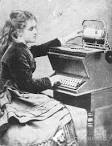
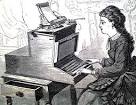
Let's look at hands and fingers of her in this drawing.
Some fingers looks almost putting on the space bar.
Mrs. Longley might not be touch typist until then and later so, almost the first human who noted to public to use thumb to push or strike down the space bar, it is not recommended but as a thing must.
Without caution like she informed, people might be apt to use other than thumbs.
And this can only happen on Remington(or Sholes&Glidden) QWERTY machine, not on Caligraph.
I've written things mentioned above, before Oct. 2010 or so at the latest, in Japanese.
https://web.archive.org/web/20101017230239/http://www26.atwiki.jp/raycy/pages/224.html
http://www26.atwiki.jp/raycy/backupx/224/list.html
But these weren't early.
Let's look at hands and fingers of her in this drawing.
Some fingers looks almost putting on the space bar.
Mrs. Longley might not be touch typist until then and later so, almost the first human who noted to public to use thumb to push or strike down the space bar, it is not recommended but as a thing must.
On thumb, at page7 bottom of
Elizabeth Margaret Vater Longley "Type-Writer Lessons for the Use of Teachers and Learners Adapted to Remington’s Perfected Type-Writers"(Cincinnati, 1882)Never strike the space-board with the fingers, but always with thumb.
Without caution like she informed, people might be apt to use other than thumbs.
And this can only happen on Remington(or Sholes&Glidden) QWERTY machine, not on Caligraph.
- There were almost only two choices they could take on keyboard typewriter having typebars, Remington or Caligraph.
- I'll write some later on an article http://bqaa.blogspot.jp/2014/03/it-s-apparent-getting-into-era-typing.html
On her book for Caligraph, there was no mention how to use thumb and read as follows:
At the bottom of page 7:Caligraph Lessons for the Use of Teachers and Learners Designed to Develop Accurate and Reliable Operators』(Cincinnati, 1882)Strike the space-bar with the little finger.
I've written things mentioned above, before Oct. 2010 or so at the latest, in Japanese.
https://web.archive.org/web/20101017230239/http://www26.atwiki.jp/raycy/pages/224.html
http://www26.atwiki.jp/raycy/backupx/224/list.html
But these weren't early.
Mrs. M. V. Longley: ``Writing Machines'', Proceedings of the First Annual International Congress of Shorthand Writers, pp.14-16 (August 31, 1882).
"the thumb will be in readiness to strike the space-bar"
- https://www.google.co.jp/search?tbm=bks&hl=ja&q=%22thumb+will+be+in+readiness+to+strike+the+space-bar%22
- http://books.google.co.jp/books?id=WaUDAAAAYAAJ&pg=RA1-PA15&dq=%22thumb+will+be+in+readiness+to+strike+the+space-bar%22
- http://books.google.co.jp/books?id=q_HL6GQi5BEC&pg=PT290&dq=%22thumb+will+be+in+readiness+to+strike+the+space-bar%22 (2009)
- http://slashdot.jp/~yasuoka/journal/411996/ (2007, Aug. 11th)
3/21/2014
"Porter's telegraph college" on papers, "Densmore & Porter" on a book
http://chroniclingamerica.loc.gov/search/pages/results/?state=&date1=1836&date2=1922&proxtext=%E2%80%9DPorter%27s+telegraph+college%22&x=18&y=19&dateFilterType=yearRange&rows=20&searchType=basic

very short period while 1868?
or 1870?
What was said on the circular of his colleges?
http://hdl.handle.net/2027/nyp.33433006345817?urlappend=%3Bseq=53I suppose as follows:
The early history of the typewriter, by Chas. E. Weller...
http://catalog.hathitrust.org/Record/001159266
Main Author: Weller, Charles Edward, 1840-1925. Language(s): English Published: La Porte, Ind., Chase & Shepard, printers, 1918. Subjects: Sholes, Christopher Latham, > 1819-1890.
Typewriters > History.Physical Description: 87 p. incl. illus., port. 16 cm.
Catalog Record: The early history of the typewriter | Hathi Trust Digital Library:
- Porter's Telegraph college
- Porter's National Telegraph college
very short period while 1868?
- Journal of the Telegraph, vol.1., No.16., July 1, 1868
- Perrysburg journal. (Perrysburg, Wood Co., O. [Ohio]), November 20, 1868, Image 4
- Perrysburg journal. (Perrysburg, Wood Co., O. [Ohio]), November 27, 1868, Image 4
- Perrysburg journal. (Perrysburg, Wood Co., O. [Ohio]), December 04, 1868, Image 4
or 1870?
What was said on the circular of his colleges?
Subscribe to:
Posts (Atom)